
Hul'qumi'num: kwumsuli'qw (mushroom)
Latin: Hericium abietis
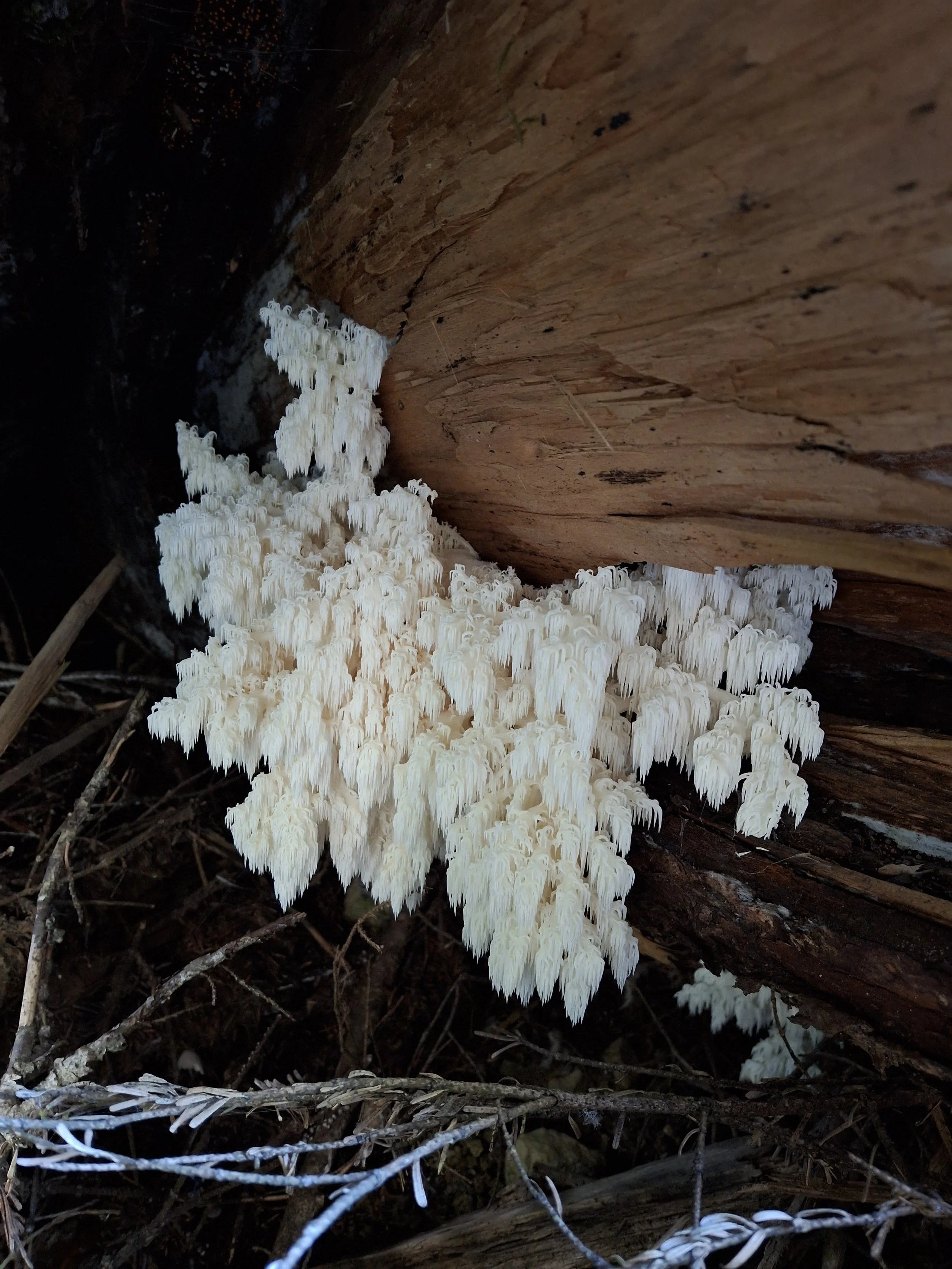
Photo Credits: Flora Lake
Description: Bear’s Head is part of the toothed fungi family. These fungi are uniquely identifiable in that they don’t have gills or pores, but many teeth that hang down where gills or pores would usually be present. Bear’s Head can be found growing on (dead) old-growth conifer logs or stumps. It is often nestled on the underside or inside of a log. Bear’s Head is structured in branching clusters of these teeth, starting smaller when young and expanding in both individual tooth length and overall size with age. A young Bear’s Head can look quite different from a mature one, see pictures above (mature) and below (young). Teeth range in size from 0.5cm to 1.5cm, and the overall fruiting body can reach around 30cm wide and 50cm long. On the larger end, Individual mushrooms can reach 50lbs! Bear’s head starts off white but fades to a yellow or salmon-like colour with age or bruising. Its spore print is white.
Look-a-like: Bear’s Head may look very familiar as it is a cousin (shared genus) to the well-known Lion’s Mane (Hericium erinaceus). Lion’s mane, you’ll find, is much more densely packed than Bear’s Head, but with likely longer teeth. It has a similar colouration, but you can also distinguish it as Lion’s Mane grows on deciduous trees (sometimes living), not dead conifers as Bear’s Head prefers. Lion’s Mane is an edible and choice mushroom, so whether you have a Bear and a Lion, you are in for a treat.
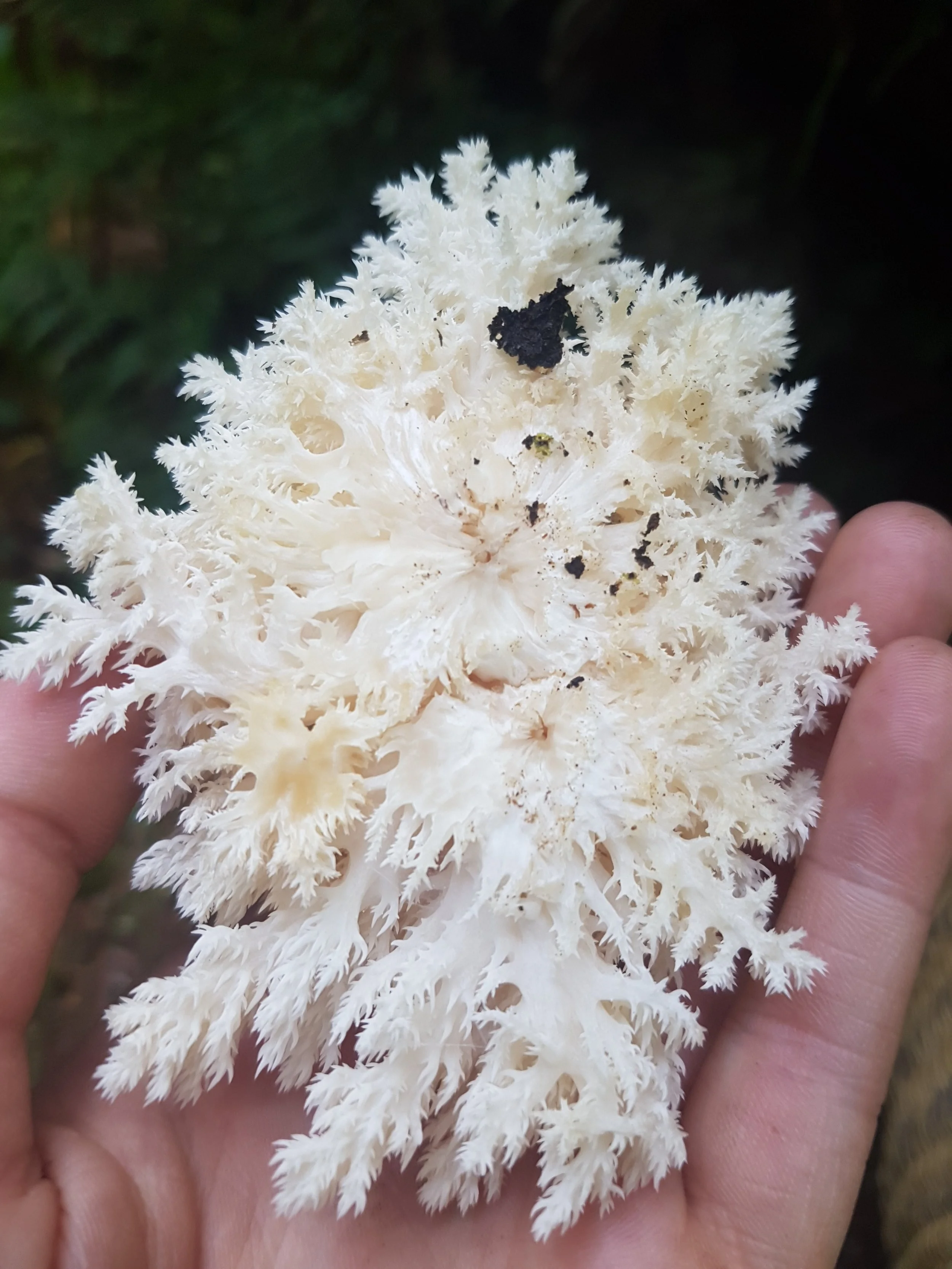
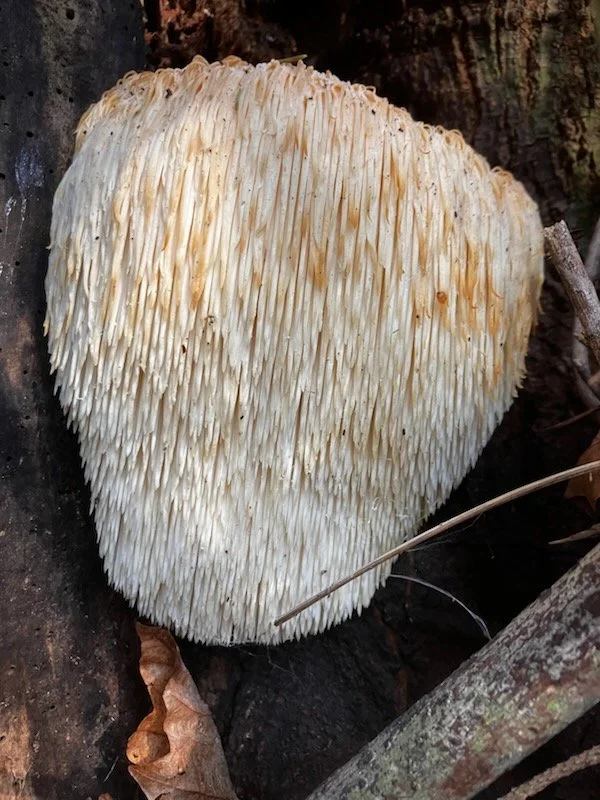
Left: Coral Tooth Fungus (Hericium coralloides) / Right: Lion’s Mane (Hericium erinaceus)
Harvest and Sustainability: You can find Bear’s Head as early as August and into late fall, but it peaks in mid-fall. It is a species of mushroom that will fruit on the same log year after year. So if you find a flush of Bear’s Head, take note of time and place! You have just secured yourself a source of this delicious mushroom for years to come. As a mushroom that fruits in the same spot every year, it is, of course, best practice to respect its habitat and only take what you need. You can visit it more than once for multiple harvests!
My greatest luck with Bear’s Head was in a mid/high-elevation, old-growth hemlock cut block in late September. Unfortunately, the great flush of mushrooms I witnessed there was due to very unsustainable forestry practices that left many massive and beautiful logs behind, but on most of these logs, Bear’s Head was fruiting. These conditions are something to consider when foraging for a species that prefers a dead host. You may also find similar conditions in areas that have experienced windthrow.
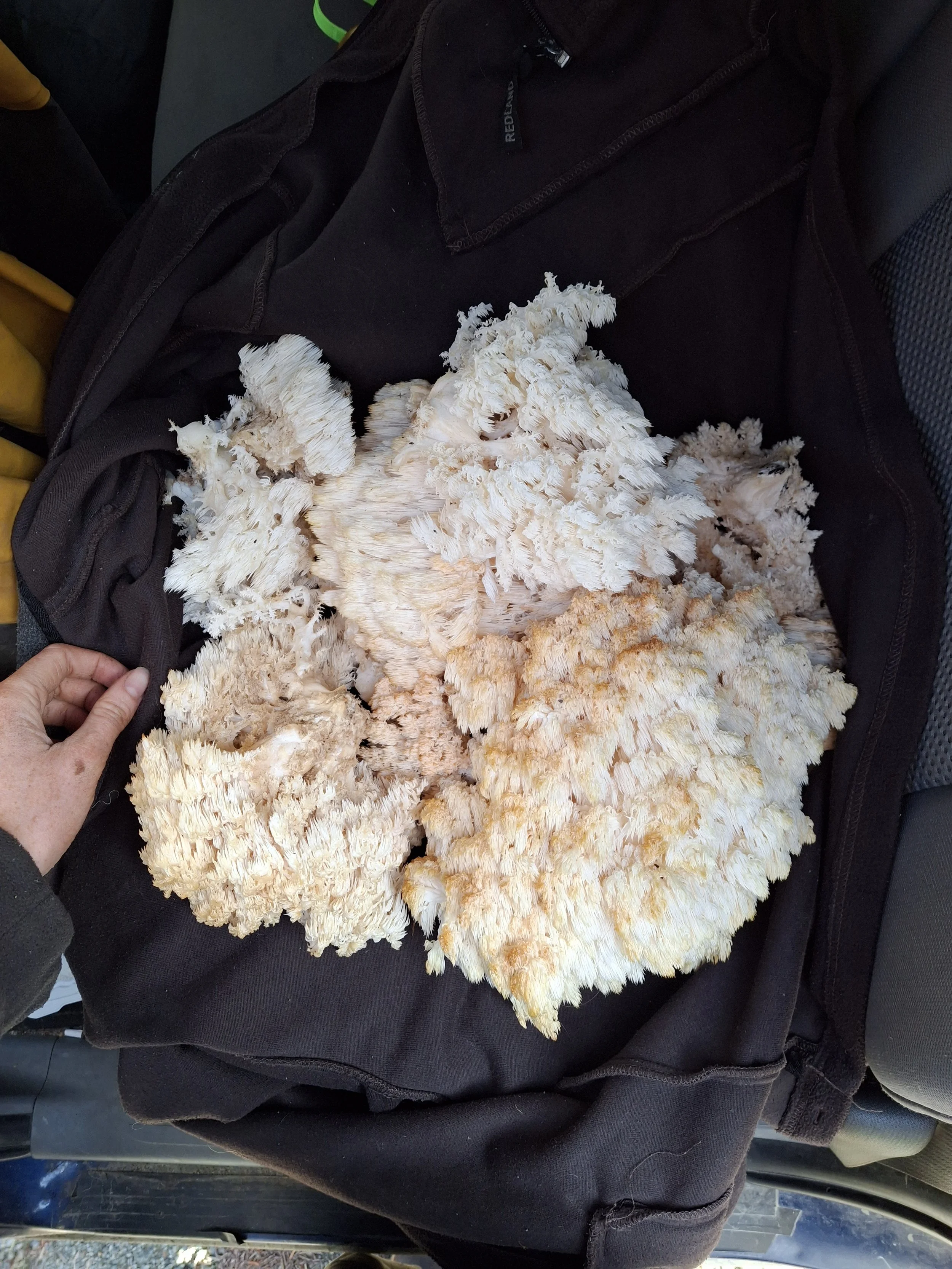
Photo Credits: Flora Lake
Uses: Bear’s Head, similar to Lion’s Mane, is a delicious and choice mushroom. It is wonderful sauteed in a stir fry, or more asian-style dishes (ramen). I have tried to inquire about the nutritional properties since they are so closely related, and Lion’s Mane has countless studies exploring its benefits to memory and brain function, immune health, reducing inflammation, heart health, and so much more. I figured they must share some of these properties, but I can’t find as many studies for this particular mushroom. Some sources do claim that all in this family of mushrooms support the same properties as Lion’s Mane, which I could see being highly probable. Especially for Bear’s Head, which prefers growing in old-growth forests that are the richest and most biodiverse, that quality would be reflected in the quality of the mushroom. Perhaps its required habitat is why it is less studied, unlike the Lion’s Mane, which has been cultivated.
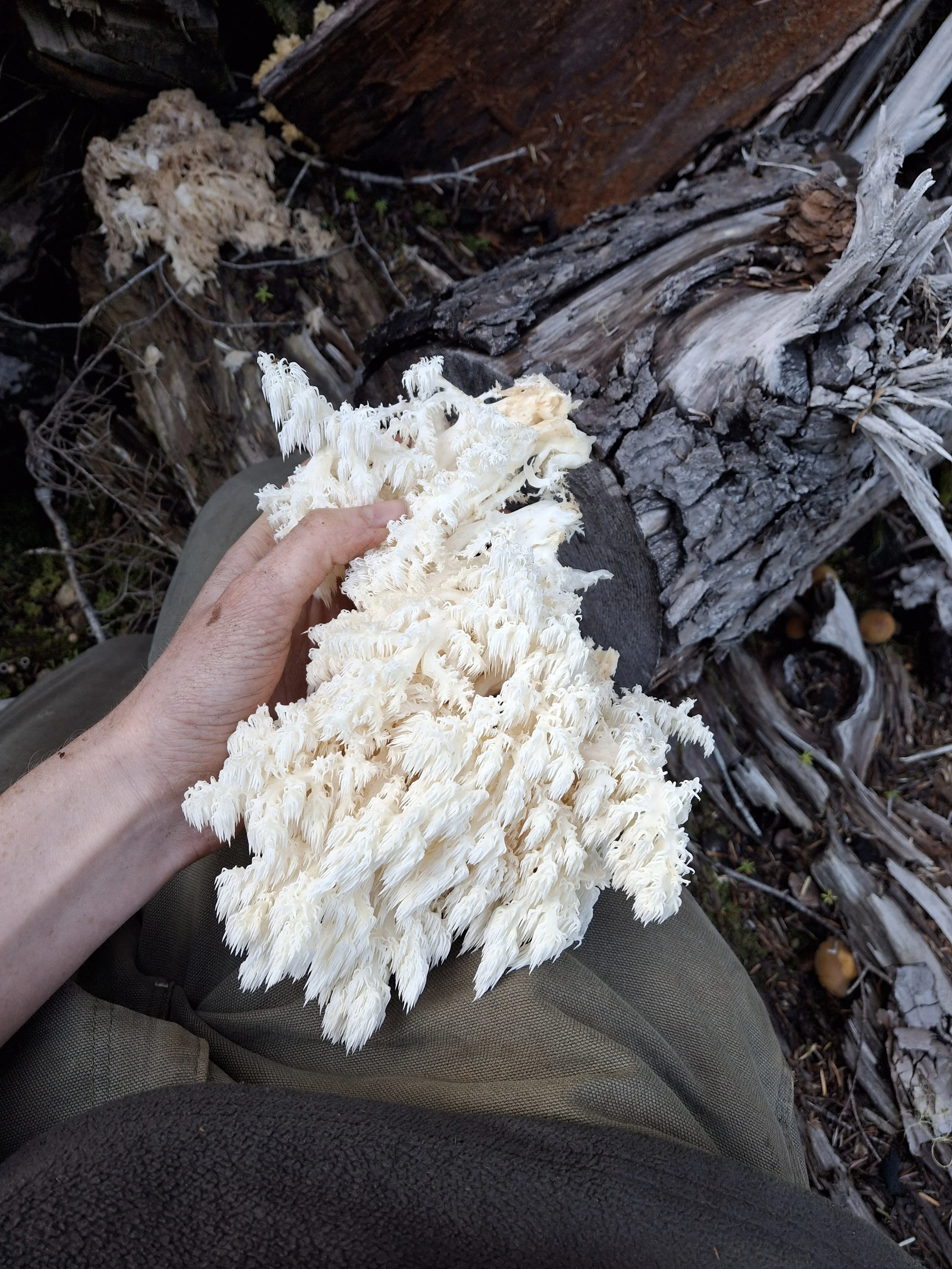
Photo Credits: Flora Lake
