
Hul'qumi'num: kwumsuli'qw (mushroom)
Latin: Hericium erinaceus
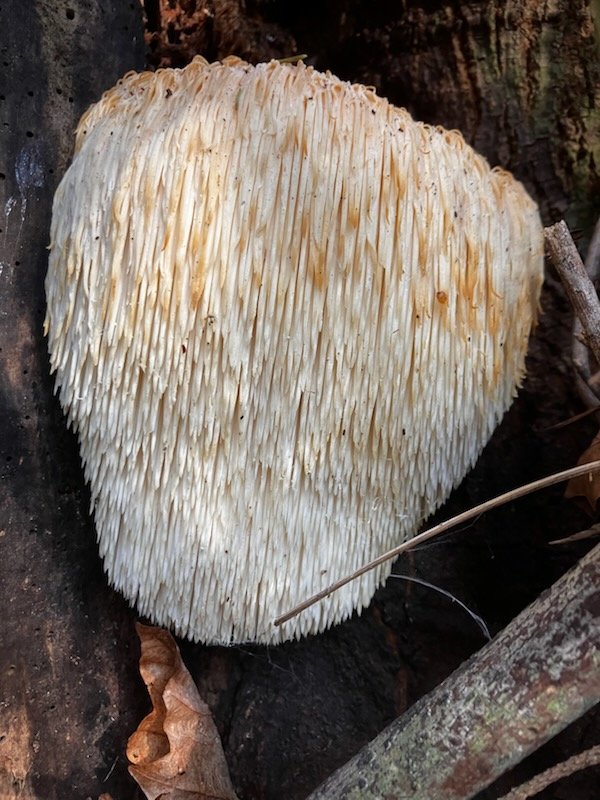
Photo Credits: Demi Kelly
Description: Lion’s Mane is a part of the toothed fungi family. These fungi are uniquely identifiable in that they don’t have gills or pores, but many teeth that hang down where gills or pores would usually be present. Lion’s Mane prefers to grow on living or sometimes dead hardwood trees, favoring oaks, maples, and beeches. The structure of its fruiting body is unbranched, with long teeth that point downwards to create large, sometimes stacked, rounded masses. They generally grow to be 12-25cm with long teeth, around 1-4cm. Their colour is white-cream, but turning a yellow/orange with age. Their spores are colourless, but the mushroom will show a white spore print.
Look-a-like: Lion’s Mane is a cousin (shared genus) of Bear’s Head (Hericium abietis) and Coral Tooth Fungus (Hericium coralloides). Fantastic common names for some majestic fungi. As I write this, I realise that these names do pretty well in describing their appearances and differences. For Lion’s Mane, you will find it has the longest and most densely packed teeth, resembling the hair of a lion’s mane. For Bear’s Head, its teeth are shorter, and its structure is branching, looking more fluffy like that of a bear’s head. Finally, the Coral Tooth, with the shortest teeth more or less evenly distributed on its branches, looks very similar to an oceanic coral. They all have similar colouring, but you will find Bear’s Head to be hosted by dead conifers, where Lion’s Mane and Coral Tooth will be growing from living (sometimes dead) hardwoods. All are edible and choice mushrooms, so either way, you are in for a treat!

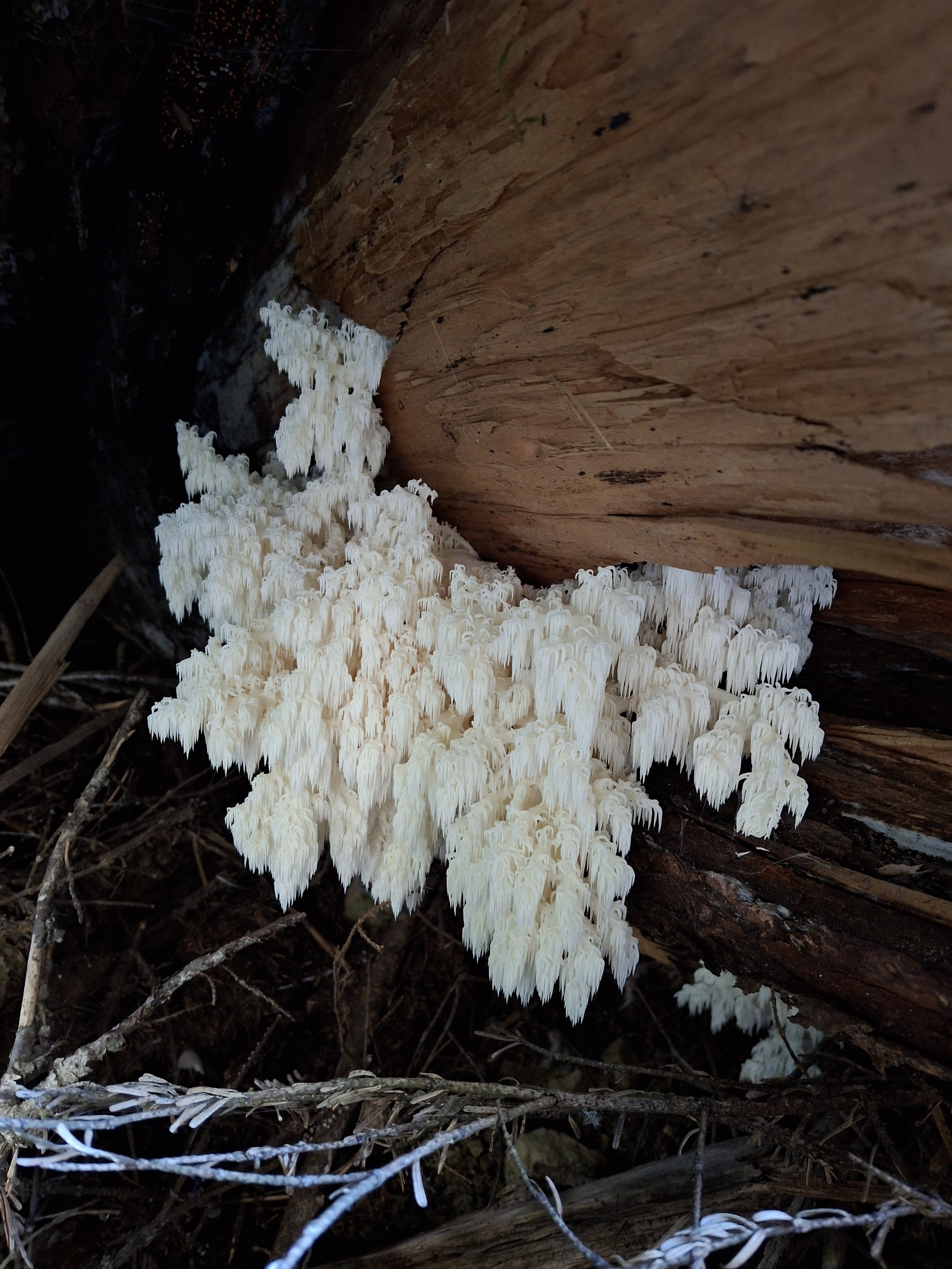
Left: Coral Tooth Fungus (Hericium coralloides) / Right: Bear’s Head (Hericium abietis)
Harvest and Sustainability: Lion’s Mane is somewhat more rare to find, but you will find it growing from August to November. It will continuously fruit in the same area or on the same trees where the mycelium is inoculated. So if you are lucky enough to find Lion’s Mane in the wild, save the spot and time of year! Check back in through the season and in the following years for continuous harvests. Always, as a general rule, respect the habitat and the fungi, and only take what you need at a time.
I have not had the pleasure of foraging Lion’s Mane, but my friend Demi has found it multiple times and has been so kind as to let me use her pictures for this mushroom profile. Thank you Demi!

Photo Credits: Demi Kelly
Uses: Lion’s Mane is a delicious mushroom that has a mildly sweet flavor that some describe as similar to seafood. It does really well in stir-frys and has a lovely, tender texture. It is also a well-studied fungi for its many benefits, most notably for its support of cognitive function. It is also rich in vitamins and minerals, giving it a high nutritional value.
Some more potential benefits:
Fighting neurological diseases, such as Alzheimer's and dementia
Anti-inflammation
Supports immune health
Support of mental health (reduced anxiety and depression)
Nerve regeneration
Diabetes management
Protection of ulcers in the digestive tract
Of course, Lion’s Mane can be tinctured to extract the potency of all its qualities. This is a source on the general process of making a double extraction tincture: https://modern-forager.com/making-medicinal-mushroom-tincture/
If you desire, it also does well being dehydrated to preserve it for future rehydration. Or to be ground up and added to meals or made into capsules.
This mushroom has also been widely cultivated, so you can more readily purchase it in capsules or tinctures if you can not find it but would like to still try it. I would highly recommend doing your own research to understand the scope of potential benefits and the limitations of studies on Lion's Mane to conclude if it is something you would benefit from taking regularly.
